

Flake Epoxy Garage Floor
The speckled garage finish that covers a slab's history, with the broadcast choice, a hot-day work plan and a price table from one bay to five.
Typically from $6/sq ft
Garage floors and business floors · Epoxy and polyaspartic coatings · Murrieta, CA
Epoxy Floors Ridge Murrieta is a local guide and availability check for epoxy and polyaspartic floors in Murrieta — flake, solid-color and metallic coatings in garages from Old Town to the subdivisions east of Interstate 15, and floors for shops, kitchens, showrooms, gyms and clinics along Jefferson Avenue and Winchester Road. See a typical price for your own square footage, how the systems compare, what a 91°F July afternoon means for a work day, and whether a local coating installer has openings for your ZIP yet.
Notify me when bookings open · typical prices in about 30 seconds
Bookings aren't open yet. Leave your name and number; your message is recorded, and you'll get one message when a local installer is available.
 Illustration
AI-generated illustration. The people shown are not real installers.
Six garage pages, one for each decision: which system, how the slab is prepared and what happens to an old coating.
The speckled garage finish that covers a slab's history, with the broadcast choice, a hot-day work plan and a price table from one bay to five.
Typically from $6/sq ft

A faster-curing, generally more UV-stable top coat, with what heat and a new slab do to it and what to ask the paperwork to say.
Typically from $7/sq ft

The lowest-cost professional coating, one clean color with grit where grip matters, set beside a DIY kit in a hot garage.
Typically from $4/sq ft

The decorative garage floor of base color, metallic pigment and clear coat, with cost, care and heat notes up front.
Typically from $9/sq ft

Grinding, repair and moisture testing by slab age, the part of the job that decides whether a coating stays down.
Typically from $1/sq ft

A symptom-to-cause table for failed garage floors, the scrape test and removal methods, then the price of starting over.
Typically from $2/sq ft
 Illustration
Typical total $2,500–$3,900
 Illustration
Typical total $6,100–$10,350
 Illustration
Typical total $1,590–$3,230
 Illustration
Typical total $15,700–$35,200
 Illustration
Typical total $13,500–$24,100
 Illustration
Typical total $9,900–$21,800
Hypothetical typical projects. Pictures are AI-generated concept illustrations, not photos of completed installations; no installation was performed or arranged through this site; prices are typical Murrieta area market ranges, not quotes.
Garage or business, size, system and slab, one question at a time; the total updates as you go.
Takes about 30 seconds · no sign-up to see your range
Check availability and get your Murrieta area price range
Bookings aren't open yet — a typical Murrieta range in about 30 seconds.
Every garage system is a stack: a ground slab, a primer, a base coat, color flake or pigment and a top coat. The stack sets how the floor looks and wears; each diagram shows the layers in order.
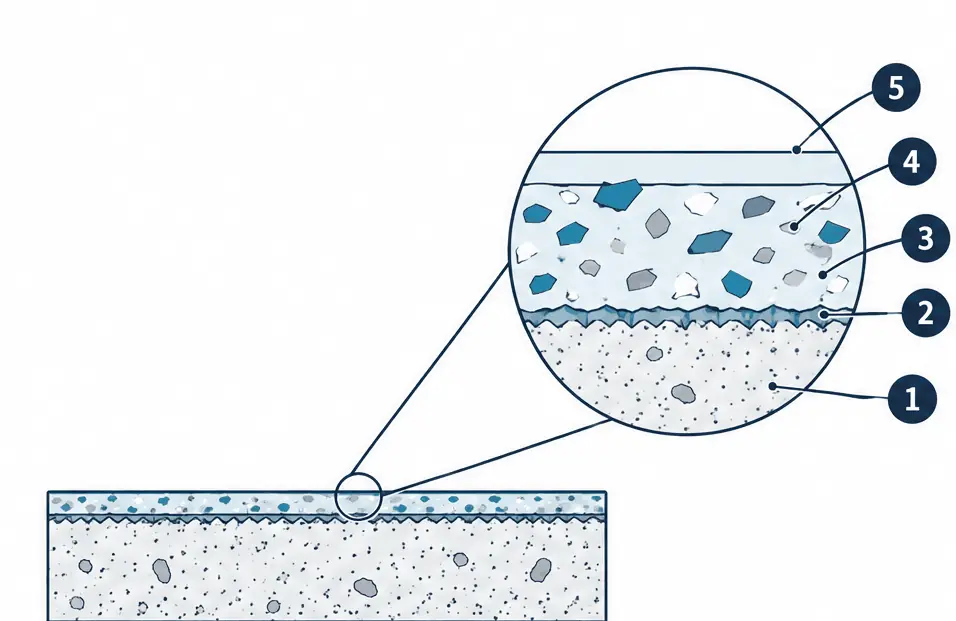
Fits Fits a tract-home garage where hiding small slab flaws and getting some texture matter more than a showroom shine.
Typically $6–$9 per sq ft about $2,400–$3,600 for 400 sq ft, installed
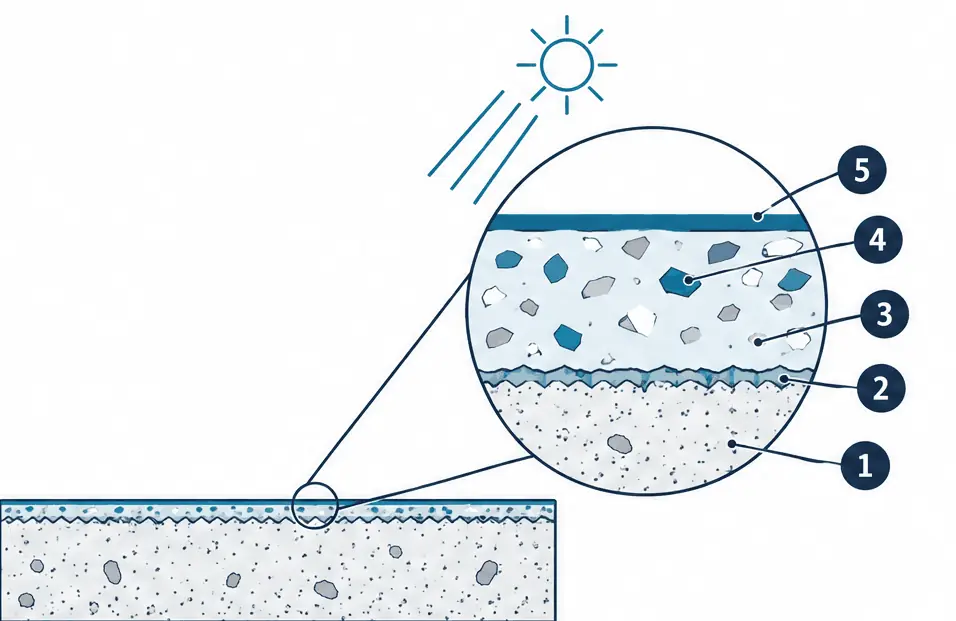
Fits Fits a garage whose door faces afternoon sun, or one that has to be back in use quickly.
Typically $7–$11 per sq ft about $2,800–$4,400 for 400 sq ft, installed
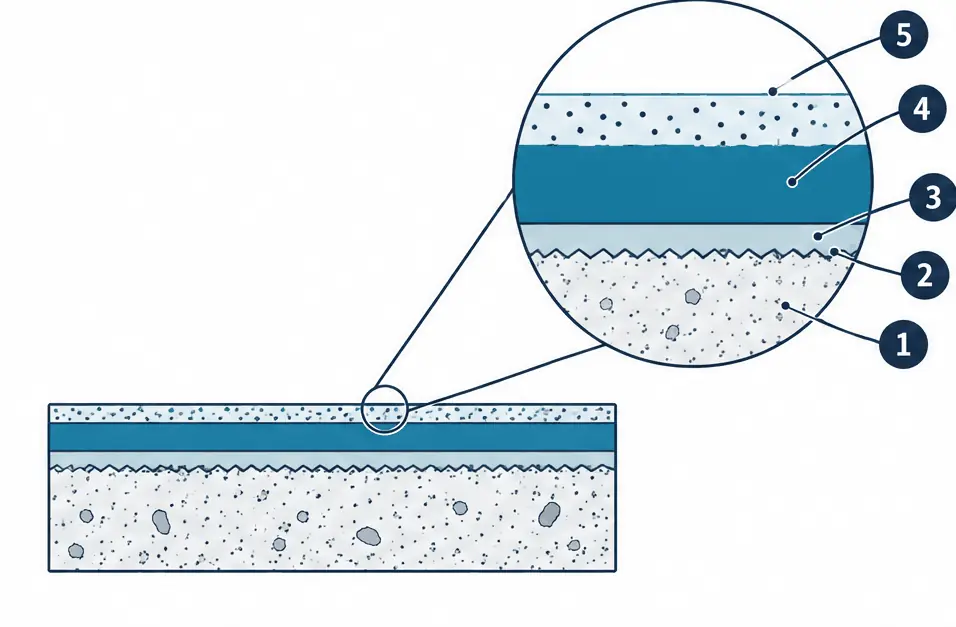
Fits Fits a workshop or a budget refresh where a plain, easy-to-clean surface matters more than a decorative finish.
Typically $4–$7 per sq ft about $1,600–$2,800 for 400 sq ft, installed
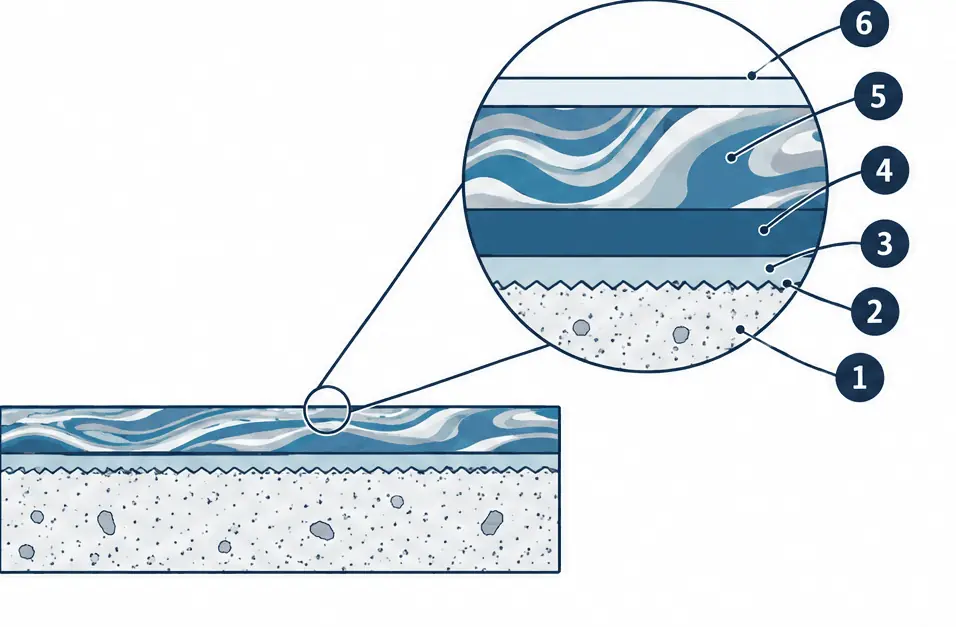
Fits Fits a showpiece garage where the swirled, depth-of-color look is the point and the slab is in good shape.
Typically $9–$13 per sq ft about $3,600–$5,200 for 400 sq ft, installed
Every product argues for itself, so here are the trade-offs side by side. Polyaspartic is one kind of polyurea, and many garage systems use an epoxy base with a polyaspartic top coat. Cost bands are the typical Murrieta prices from the estimator on this page.
| System | Sunlight | Install speed | Odor and cure | Estimator range, per sq ft | Typical weak spot |
|---|---|---|---|---|---|
| Flake (chip) epoxy with epoxy top coat | Can amber in sunlight, noticeable with the door open | Longer working time; often several days before a car | Strong odor while curing; slower cure | $6–$9 flake | Thin top coat, weak prep, hot-tire pickup |
| Epoxy base with polyaspartic top coat (hybrid) | Top coat is generally more UV-stable | Often a day or two, depending on the product | Odor while curing; return time set by the data sheet | $7–$11 polyaspartic flake | The bond to the slab, so it depends on the grind |
| Polyaspartic or polyurea throughout | Generally UV-stable | Many systems install in one day | Strong odor in the first days; short working time in heat | $7–$11, depending on the system | Short pot life; sensitive to a damp slab |
| Solid-color epoxy, grit in the top coat | Can chalk or amber in direct sun | Often two days | Strong odor while curing | $4–$7 solid color | Thin film, bare spots, slippery if grit is left out |
| Metallic epoxy with a clear top coat | Depends on the clear coat chosen | Skilled application, several days before a car | Strong odor while curing | $9–$13 metallic | Uneven slab shows, bubbles and pinholes, scratches show |
Values are general product behavior, not a promise; the data sheet of the named product and the day's temperature and humidity decide. The hybrid and polyurea rows reuse the polyaspartic band. Market estimates, not a quote.
Murrieta is young. It incorporated on July 1, 1991, and went from 1,628 residents at the 1990 census to 44,282 in 2000 and 103,466 in 2010. Almost every garage slab here is therefore between a few months and about thirty-five years old, and the summer sun at 1,096 feet is hot: the mean afternoon high is 91°F in July and August.
| Census year | Murrieta population | What it means for a garage floor |
|---|---|---|
| 1990 | 1,628 | Almost no tract housing yet; the oldest garage slabs are from the 1980s or earlier, and rare |
| 2000 | 44,282 | The 1990s subdivisions: slabs about thirty years old, hairline cracks, patched or painted floors |
| 2010 | 103,466 | The 2000s subdivisions: slabs about twenty years old, often clean, sometimes with a past sealer |
| 2020 | 110,949 | Slower growth; the newest slabs are the ones where age and moisture are the first questions |
A slab poured in the 1990s has been through three decades of summer heat and a few cool nights a year, which is enough to open shrinkage cracks along the control joints. They are usually a repair line, not a reason to skip a coating: cracks are routed, filled and ground flush, and a moving crack can show again.
A tract-home slab can be a few months old when the first owner thinks about a floor. Manufacturers commonly advise at least 28 days after the pour and in some conditions up to 60, and they also say a moisture test decides; the installed system sets the level the slab may read. Age alone is a clue, and the reading is the answer.
Most of Murrieta's newer neighborhoods have a homeowners association. The inside of a garage is usually not covered, while contractor parking, working hours and an open garage door sometimes are. A short note to the management company that names the address, the dates, the fact that the work is inside the garage and where the crew parks saves a stop-work call; the CC&Rs decide, not this site.
At 91°F the working time of a fast-curing product shrinks, which is why summer jobs start early and why the slab is checked with a thermometer before mixing begins.
General guidance from census figures, climate tables and coating-maker advice, not measured data for a specific slab. The data sheet and the homeowners association decide what applies.
A warehouse aisle, a restaurant kitchen and a clinic floor want different systems. Each kind has its own page with a zone-to-system table, a downtime plan and the questions to ask a contractor.
IllustrationAisle, apron and joint planning for warehouse and light-industrial floors, with a hot-door section and a two-zone sample budget.
Often considered Solid-color epoxy with grit
Typically from $4 per sq ft
IllustrationUrethane cement and epoxy for kitchens and food areas, coved bases and the county plan check explained.
Often considered Urethane cement (heat and washdown areas)
Typically from $10 per sq ft
IllustrationBay-by-bay choices for repair shops, with lift-pad cautions, fluid exposure and a three-bay sample budget.
Often considered Solid-color epoxy with grit
Typically from $4 per sq ft
 Illustration
Decorative flake and quartz for strip-center stores and showrooms, with glare, scuff and phasing advice.
Often considered Decorative flake (chip) epoxy
Typically from $6 per sq ft
 Illustration
Coating and rubber zones for gyms and studios, with wet-area notes and a plan for staying open between classes.
Often considered Decorative flake (chip) epoxy
Typically from $6 per sq ft
 Illustration
Seamless, easy-to-clean floors for private medical, dental and veterinary suites, installed room by room.
Often considered Solid-color epoxy with grit
Typically from $4 per sq ft
Price a business floor Each kind of floor has its own page under Commercial floors in the menu.
 Walk and measureThe garage is cleared, measured wall to wall and looked over for cracks, oil, old paint, damp patches and the joints cut when the slab was poured.
 GrindA diamond grinder with a dust shroud and a vacuum scuffs the concrete to an open, even profile; an acid etch alone grips less.
 Fill and testCracks and spalls are routed, filled and ground flush, and moisture is tested where the product data sheet calls for it, since a slab can be old and still read wet.
 Base coat, then flakesOn a warm day the base coat goes down early, while the slab is cool, and color flakes are broadcast by hand to full or partial coverage.
 Scrape and sealLoose flakes are scraped and vacuumed before a clear top coat is rolled on to seal the surface and set the gloss and behavior in sunlight.
 Wait for the data sheetPeople walk on it and cars come back only after the times on the product data sheet for that day's temperature and humidity.
Check the contractor's license at cslb.ca.gov before signing; work above $1,000 requires one.
Pick a base color and two to four flake colors. The swatches show the same mix as a full broadcast, where the flakes hide the base completely, and as a partial broadcast, where the base shows between them.
On-screen approximation; ask for a physical sample board.
Epoxy Floors Ridge Murrieta covers Bear Creek, Greer Ranch, Los Alamos Hills, Alta Murrieta, Murrieta Hot Springs, Old Town Murrieta, Jefferson-Madison corridor, French Valley — pick your neighborhood from the menu for local details and ZIP codes.
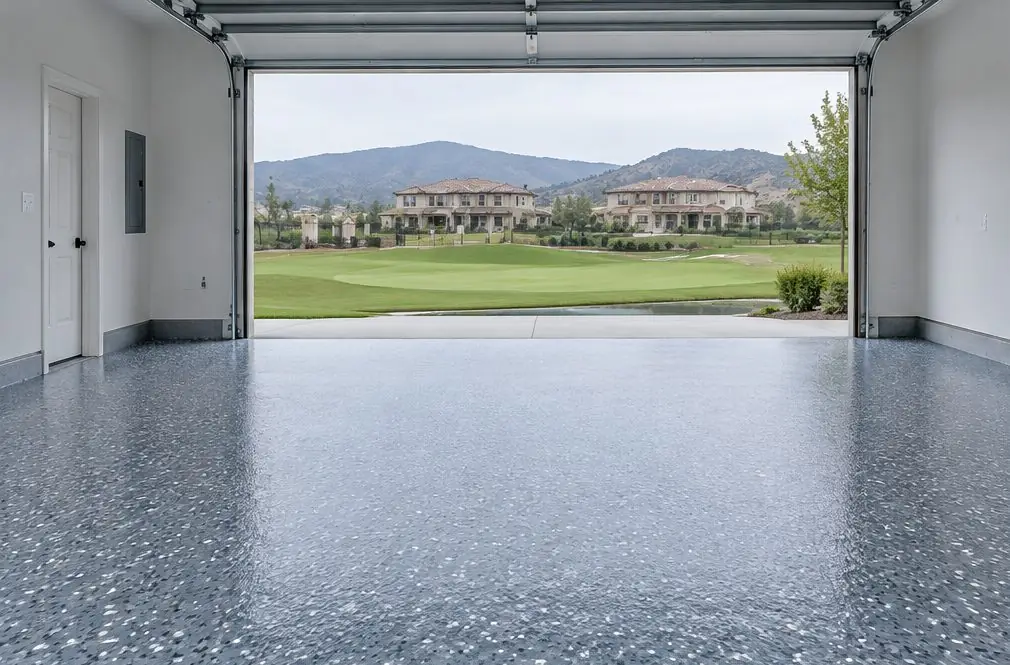
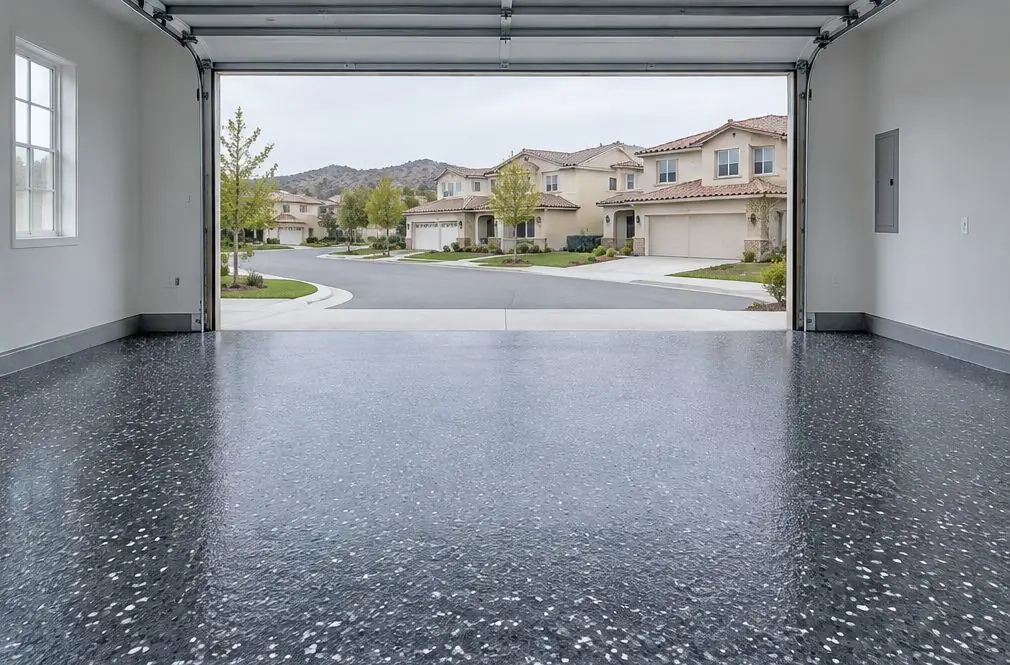
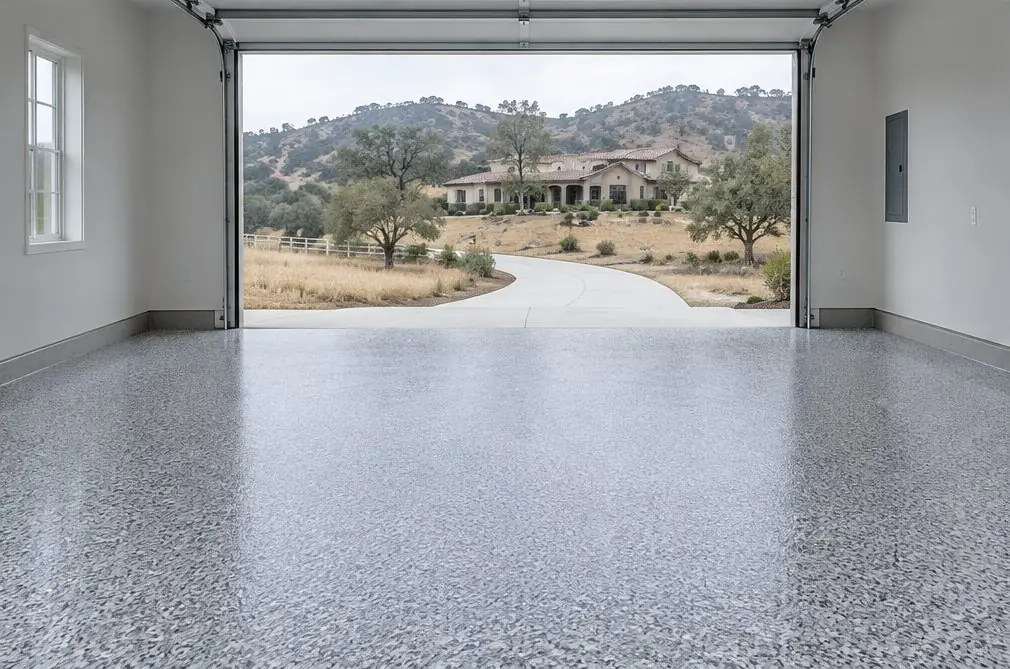
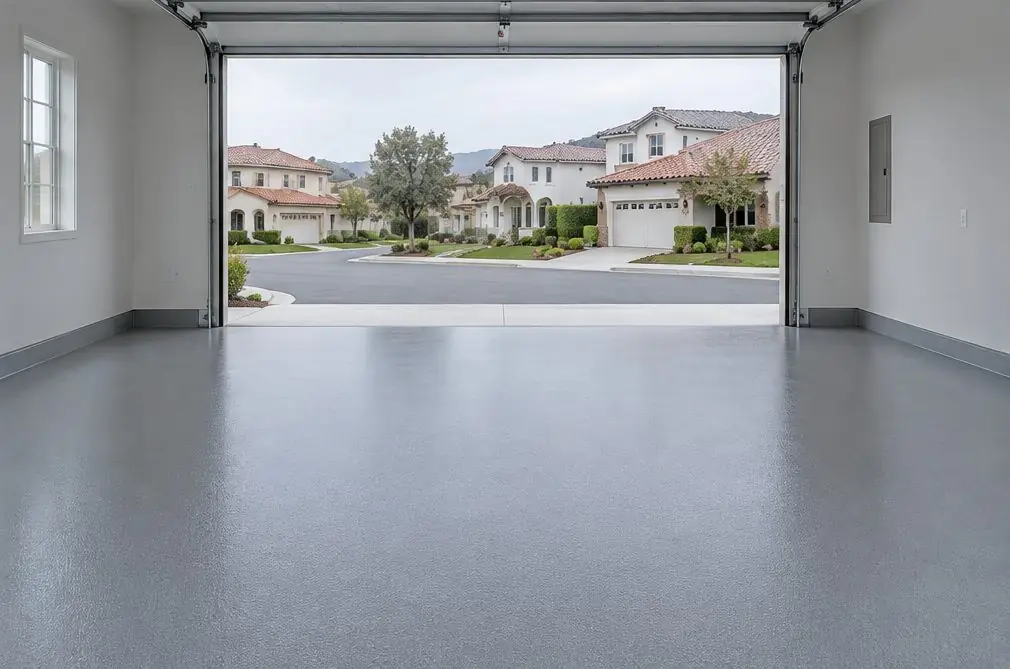
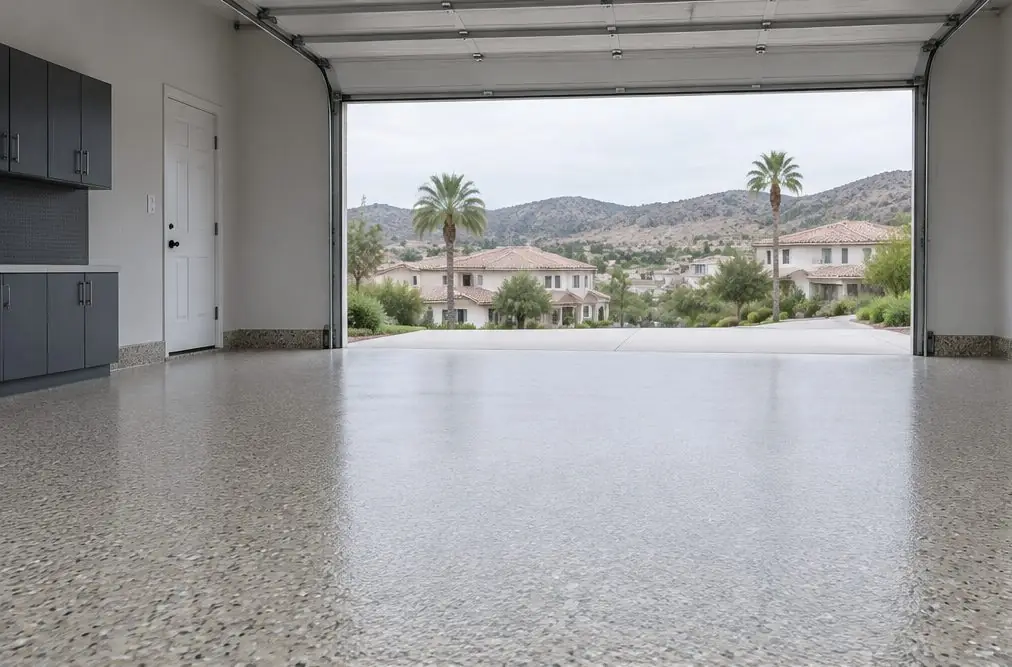
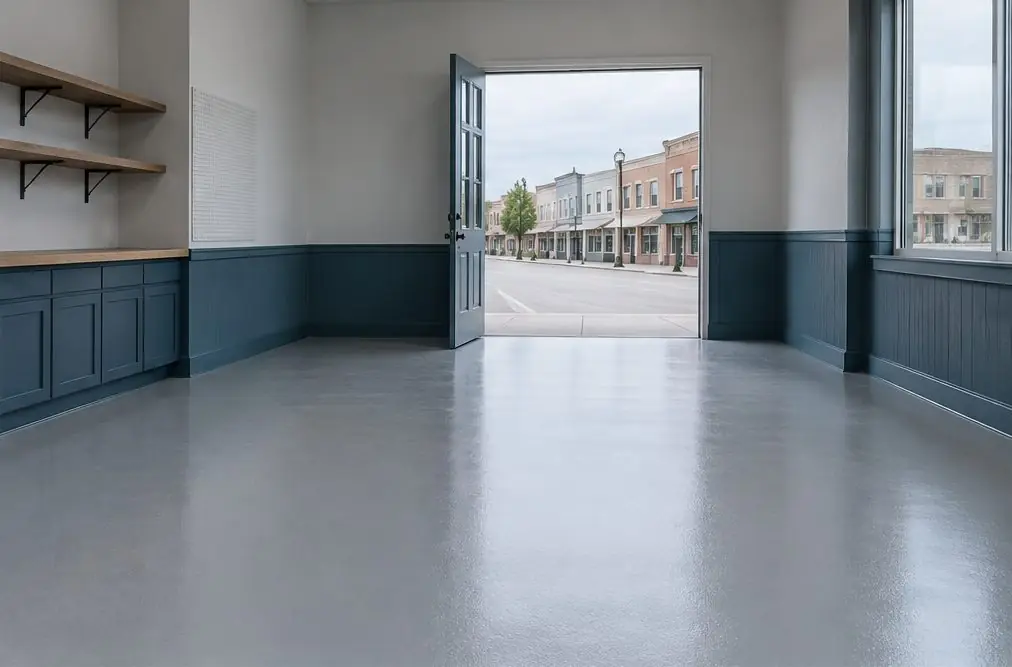
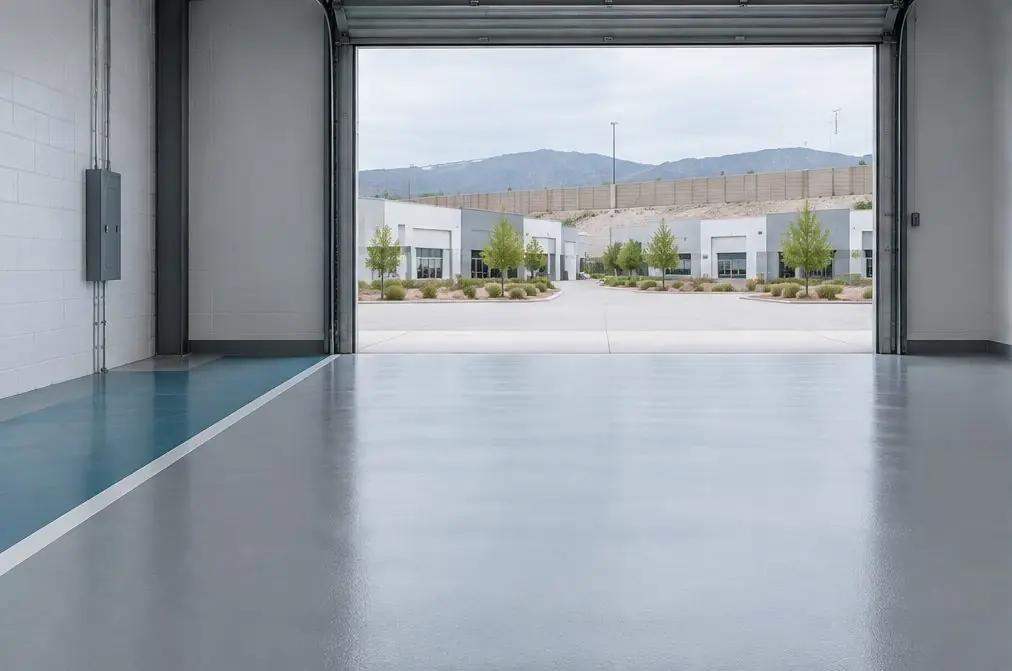
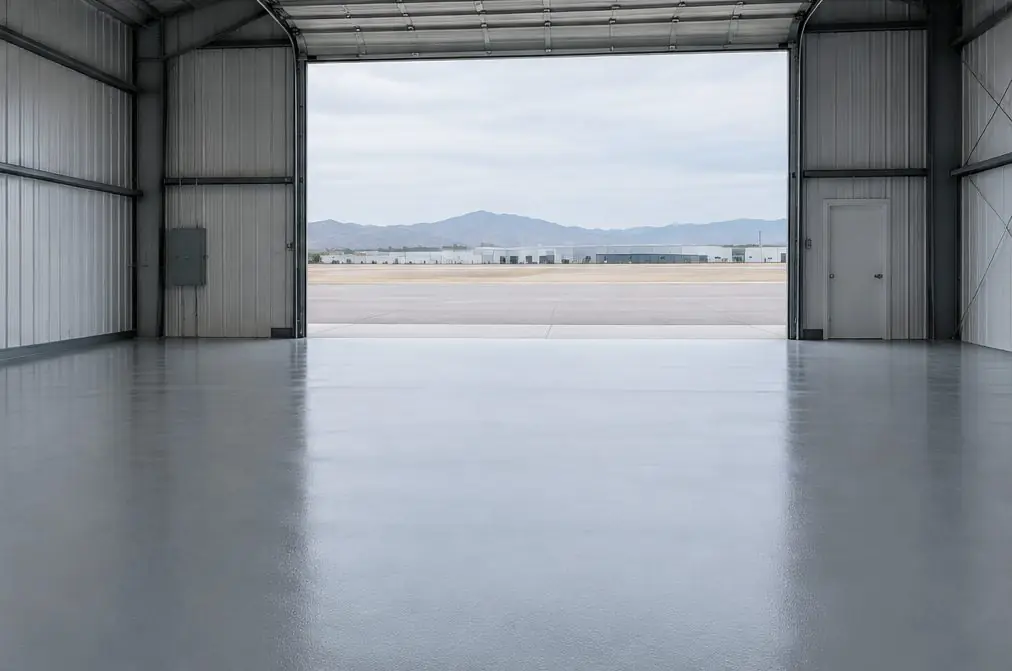
In 2026 a typical Murrieta range is about $6–$9 per square foot for flake epoxy, $7–$11 for polyaspartic flake, $4–$7 for solid color and $9–$13 for metallic, on a sound slab. A 2-car garage of about 400 square feet in flake epoxy lands near $2,400–$3,600. Cracks add $1–$2 per square foot and removing an old coating $2–$5. These are market estimates, not quotes.
It depends on the garage. Polyaspartic and polyurea top coats are generally more UV-stable than standard epoxy and cure faster; epoxy is often used as a base coat because it has a longer working time and bonds well to a ground slab. A garage door that faces afternoon sun is a reason to look at a polyaspartic top coat.
Many polyaspartic systems can be installed in one day. Foot traffic usually resumes the next day, and vehicles return after the time on the product's data sheet, often 24 hours to several days depending on the product, temperature and humidity. Epoxy systems usually take longer, often several days before a car.
Possibly not yet. Manufacturers commonly advise at least 28 days after the pour and in some conditions up to 60, and they say a moisture test decides. A slab can be old enough and still read wet, so ask for a test, ideally in-slab humidity probes.
Most peeling traces back to the slab: a surface that was only etched or swept, moisture vapor coming up through the concrete, a builder sealer left on, or a coating applied over old paint, oil or a weak layer. The prep and moisture guides on this site list the signs.
Hot-tire pickup — a warm tire lifting the coating — is mostly a prep and product problem; a ground slab and a system rated for it reduce the risk. After a drive on a 91°F afternoon the risk is highest on a thin, poorly adhered top coat.
A slab with moisture vapor coming up through it can push a coating off. Many installers test before coating (a calcium chloride test, ASTM F1869, or in-slab relative humidity probes, ASTM F2170), and where readings are high, a moisture-mitigating primer is used or the job is reconsidered.
Sometimes. A sound, well-adhered coating can be ground and recoated; peeling, chalky or glossy-over-paint surfaces are removed first. A small test grind shows which one the floor is.
The inside of a garage is usually not covered by the association, but the CC&Rs decide, for example about contractor parking, working hours and an open garage door for a day or two. A short note to the management company before the work, with the address, dates and where the crew parks, keeps it simple.
A coated floor can be slippery when wet or oily. Broadcast flake and a fine grit added to the top coat add texture and grip, and the amount of grit is a choice between grip and ease of cleaning.
Yes. The commercial pages cover warehouses, restaurant kitchens, auto shops, retail and showroom floors, gyms and private clinics, with a downtime planning guide and a separate business path in the calculator.
In California, floors in food facilities must be smooth, durable, nonabsorbent and easily cleanable, with a coved base where floor meets wall (California Retail Food Code, Health and Safety Code §114268). Kitchens with hot-water washdowns often use urethane cement systems, which tolerate heat and thermal shock better than standard epoxy. The Riverside County Department of Environmental Health reviews plans for new or remodeled food facilities.
Commercial installs are often scheduled after hours, on weekends or in phases, so part of the floor stays in use. Return to foot traffic, carts and forklifts depends on the system, temperature and humidity and is set by the product's data sheet.
Homes and businesses across Murrieta and the valley next to it — Bear Creek, Greer Ranch, Los Alamos Hills, Alta Murrieta, Murrieta Hot Springs, Old Town, the Jefferson-Madison business corridor and French Valley. The availability check shows whether openings exist for a ZIP.
Installers featured on this site are independent businesses. The installer's legal name and business details are published on this site before bookings open. Warranty terms, if any, are set by the installer and by the coating manufacturer; ask what is covered, for how long, and whether the prep is part of it.
Typical Murrieta area floor coating prices, square foot by square foot
Pick garage or business, the size and the system, and see the range. No contact details needed. Bookings open here once a local installer is named on this site.
Bookings aren't open yet. Leave your name and number; your message is recorded, and you'll get one message when a local installer is available.